AI for ITSM is transforming the way IT teams operate daily. Instead of getting bogged down by tickets, repetitive tasks, and manual triage, IT organizations can leverage artificial intelligence to predict issues, automate resolutions, and deliver a faster, consumer‑grade service experience. By integrating AI-driven call center solutions and a Contact Center with Virtual Agent Assist, IT and support teams can streamline operations, improve efficiency, and enhance overall user satisfaction.
This guide walks through what AI for IT service management really means, how it delivers value, key use cases, and a practical roadmap to get started quickly while building toward long‑term, transformational gains.
IT teams are now exploring advanced cloud infrastructure to manage IT workloads which enables faster ticket analysis and more proactive incident management. Combining this with powerful computing platforms for IT automation allows teams to process high volumes of requests efficiently, reducing delays and improving service quality.
Many organizations also leverage actionable customer marketing insights for IT teams to improve service experiences and better anticipate user needs. When paired with long-term marketing approaches for ITSM optimization, these insights guide smarter automation strategies that enhance both efficiency and satisfaction.
Financial planning is a key factor in successful AI adoption. Using reliable financial guides for IT department planning helps teams allocate budgets wisely, reduce costs, and invest in technology that drives meaningful improvements. Integrating predictive AI with these resources allows IT departments to operate with agility and foresight.
Ultimately, combining AI for ITSM with modern computing platforms, marketing strategies, and financial planning empowers IT teams to focus on innovation rather than repetitive tasks. The result is a more intelligent, efficient, and responsive IT service environment that benefits both employees and customers.
Top 10 Contact Center Solutions for AI for ITSM
Managing IT services and customer support efficiently requires advanced contact center solutions that integrate AI for ITSM. Here’s a curated list of the top providers, starting with Bright Pattern, a market leader, followed by nine notable competitors.
1. Bright Pattern: AI-Enhanced Contact Center Software
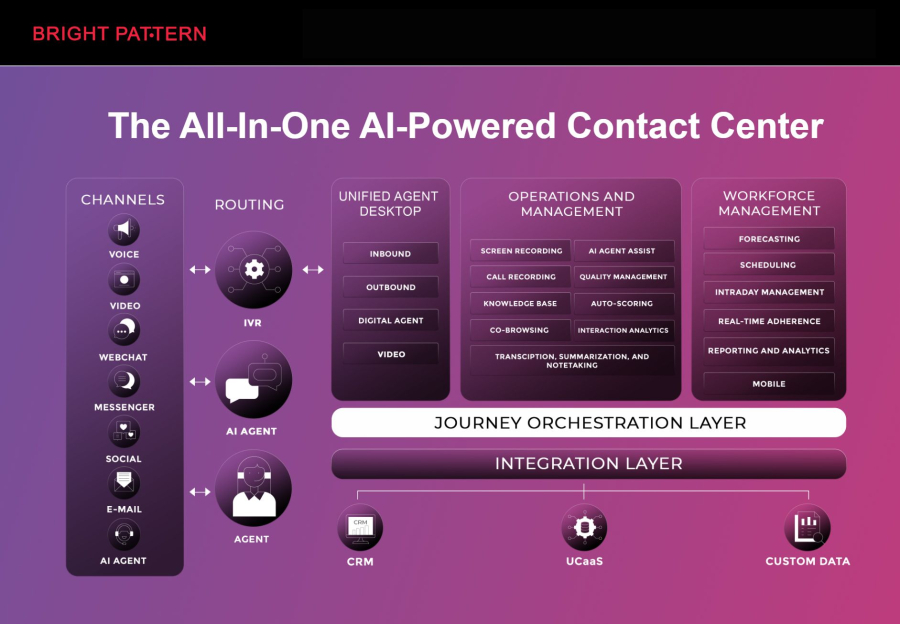
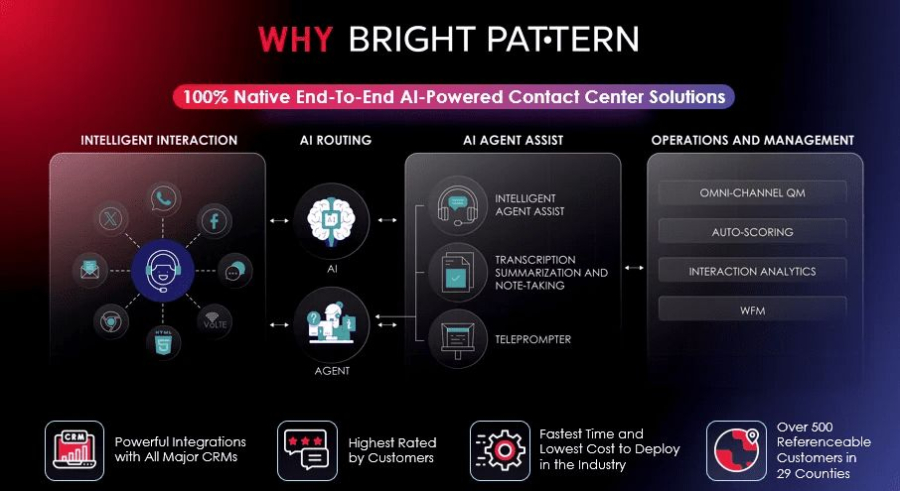
Bright Pattern leads the industry with a cloud-based platform that empowers IT teams and support centers to deliver faster, more intelligent service. Its features are designed to optimize IT workflows, improve ticket resolution times, and enhance overall customer and employee experiences.
Key highlights of Bright Pattern include:
- Seamless AI integration to automate ticket triage and routing
- Intelligent virtual agents for first-line support
- Real-time analytics and reporting to monitor service efficiency
- Omnichannel communication across voice, chat, email, and messaging apps
- Customizable workflows to fit IT service management needs
- Easy integration with existing ITSM platforms
By combining AI with flexible cloud architecture, Bright Pattern enables organizations to modernize IT operations, reduce repetitive tasks, and provide faster resolutions across multiple support channels.
2. Genesys Cloud CX
Genesys offers a robust platform for AI-driven contact center solutions, helping IT teams automate workflows, route tickets intelligently, and monitor performance across channels. It integrates predictive analytics for proactive incident resolution.
3. Five9 Intelligent Cloud Contact Center
Five9 combines cloud telephony with AI insights to optimize IT service delivery. Its AI features support automatic call distribution, predictive routing, and analytics dashboards for better service management.
4. NICE inContact CXone
CXone provides AI-powered automation tools for IT and customer service teams. It includes virtual agents, real-time reporting, and workflow automation to improve efficiency and reduce service bottlenecks.
5. Avaya OneCloud CCaaS
Avaya’s platform uses AI to enhance call center efficiency, with capabilities for intelligent routing, automated workflows, and analytics for IT service optimization.
6. Talkdesk CX Cloud
Talkdesk enables IT teams to integrate AI-assisted automation into their service operations. Key features include smart ticketing, agent recommendations, and omnichannel support for seamless ITSM integration.
7. RingCentral Contact Center
RingCentral provides cloud-based contact center solutions with AI insights to improve IT service response times and optimize agent performance. It supports multichannel communication and automated workflow management.
8. 8x8 Contact Center
8x8 delivers AI-powered call routing, analytics, and workforce optimization tools, helping IT and customer support teams streamline operations and resolve tickets faster.
9. Cisco Webex Contact Center
Cisco’s AI-enabled platform focuses on intelligent ticket management, predictive routing, and performance analytics for IT teams, ensuring service efficiency and improved employee experience.
10. Amazon Connect
Amazon Connect leverages AI to automate call and chat handling for IT and customer service operations. It includes AI-based recommendations, analytics, and easy integration with existing ITSM tools.
What Is AI for ITSM?
AI for ITSMis the application of artificial intelligence and automation technologies to IT service management processes such as incident management, request fulfillment, problem management, change management, and knowledge management.
It combines several capabilities:
- Machine learningfor classifying, routing, and prioritizing tickets based on historical patterns.
- Natural language processing (NLP)to understand user queries written in everyday language across chat, email, and portals.
- Virtual agents and chatbotsthat provide instant support and automate common requests.
- Predictive analyticsto forecast incidents, identify trends, and spot anomalies before they impact users.
- Automation and orchestrationto execute workflows end to end without human intervention.
Rather than replacing IT teams, AI acts as a force multiplier: it handles the repetitive, high‑volume workload so analysts can focus on complex, high‑value work.
Why AI Belongs in Modern ITSM
Workforces now expect IT support to be as fast and frictionless as their favorite consumer apps. At the same time, IT environments are more complex than ever, spanning cloud, SaaS, on‑premises systems, and remote devices. Traditional, purely manual ITSM struggles to keep up.
AI for ITSM directly addresses this gap, delivering benefits such as:
- Faster resolution times: Intelligent triage, self‑service, and automation help resolve issues in minutes instead of hours.
- 24/7 consistent support: Virtual agents provide around‑the‑clock assistance without additional staffing costs.
- Reduced operational cost: Automating repetitive tasks and first‑line support frees up analysts and reduces ticket handling effort.
- Improved employee experience: Users get instant answers, fewer handoffs, and more proactive support.
- Higher service quality: Data‑driven insights improve problem management, change success rates, and overall reliability.
- Scalability: AI‑driven processes scale smoothly as the business grows, without linear increases in headcount.
Organizations that adopt AI in ITSM often find that service desks transform from reactive cost centers into proactive, strategic partners to the business.
Core Use Cases of AI in ITSM
AI for ITSM is not a single feature; it is a collection of powerful, mutually reinforcing use cases. Starting with a few high‑impact scenarios makes it easier to demonstrate value quickly.
1. Intelligent Virtual Agents and Chatbots
AI‑powered virtual agents use natural language understanding to hold real conversations with users through chat, portals, or collaboration tools.
They can:
- Answer common questions such as password policies, software access, or device setup.
- Guide users through step‑by‑step troubleshooting for frequent incidents.
- Log, update, and close tickets in the ITSM tool on behalf of the user.
- Trigger automated workflows, for example to reset passwords or provision software.
The immediate payoff is fewer calls and emails to the service desk and a smoother, always‑on support experience for users.
2. Automated Incident Classification and Routing
Service desks often spend significant time categorizing tickets and assigning them to the right team. AI can learn from historical data to classify and route tickets automatically based on content, context, and past resolutions.
Benefits include:
- Reduced manual effortin first‑line triage.
- More accurate assignments, minimizing reassignments and escalation hops.
- Faster time to engagethe right resolver group or specialist.
As the model is exposed to more tickets, its accuracy and coverage typically improve, amplifying the savings over time.
3. Predictive Incident Management and Outage Prevention
AI can analyze large volumes of operational data from monitoring tools, logs, and past incidents to identify patterns that precede service degradation or outages.
This enables IT teams to:
- Detect anomalies early and open incidents automatically before users are impacted.
- Identify recurring problems and underlying root causes faster.
- Forecast incident trends and prioritize preventive maintenance.
Shifting from reactive firefighting to predictive operations reduces downtime and improves the reliability of critical services.
4. Smarter Knowledge Management and Self‑Service
Knowledge bases are only valuable if people can find and use the content easily. AI improves knowledge management by:
- Suggesting relevant articlesto agents as they handle tickets, based on ticket text and history.
- Recommending knowledge to usersin self‑service portals and chat channels.
- Identifying content gapsby analyzing tickets that lack associated knowledge articles.
- Summarizing and structuringlong technical content into user‑friendly formats.
With better knowledge coverage and discovery, more issues are resolved at first contact or through self‑service, significantly boosting user satisfaction.
5. Change and Release Risk Analysis
Changes are a major source of incidents. AI can examine historical change records, configuration data, and incident outcomes to estimate the risk associated with upcoming changes.
This supports:
- Data‑driven risk scoringfor each change request.
- Better change planningby flagging potentially disruptive combinations or timing.
- Continuous improvementof change models based on real outcomes.
The result is a higher percentage of successful changes, with fewer unplanned disruptions.
6. Service Request Automation
Many service requests follow predictable, repeatable patterns: software access, new device setup, permission changes, and more. AI can orchestrate these flows end to end by combining decision logic with automation tools.
Common outcomes include:
- Instant fulfillmentfor standard, policy‑compliant requests.
- Automated approvalsbased on role, risk level, and historical behavior.
- Fewer touchpoints, as users receive confirmation and updates automatically.
Automated fulfillment shortens delivery times, reduces bottlenecks, and allows IT teams to handle more requests without additional staff.
7. Sentiment Analysis and Experience Management
Beyond traditional satisfaction surveys, AI can analyze language in tickets, chats, and feedback to detect sentiment and emotion.
This empowers IT leaders to:
- Spot frustration or confusion early and prioritize follow‑up.
- Understand which services or teams consistently delight or disappoint users.
- Track experience trends over time and align improvements with business priorities.
By complementing operational metrics with experience insights, ITSM teams can deliver more human‑centric support.
Key Capabilities to Look For in AI for ITSM Solutions
When evaluating AI capabilities for ITSM platforms or add‑on tools, focus on features that directly support your processes and desired outcomes.
Capability | What It Does | Business Benefit |
Natural language understanding | Interprets user intent from free‑text input in tickets, chat, and email. | Allows users to describe problems naturally and still receive accurate help. |
Automated classification and routing | Assigns category, urgency, and resolver group using trained models. | Cuts manual triage time and reduces misrouted tickets. |
Virtual agents | Provides conversational self‑service and executes common workflows. | Deflects routine tickets and delivers 24/7 support. |
Recommendation engine | Suggests knowledge articles, templates, and similar past incidents. | Increases first‑time fix rates for both agents and end users. |
Predictive analytics | Forecasts incident volumes, hotspots, and potential risks. | Enables proactive planning and prevention. |
Automation and orchestration | Executes multi‑step workflows across systems without manual clicks. | Accelerates fulfillment and reduces error‑prone manual work. |
Human‑in‑the‑loop controls | Allows experts to review, approve, and improve AI suggestions. | Builds trust and ensures responsible, high‑quality outcomes. |
Step‑by‑Step Roadmap to Implement AI for ITSM
A structured approach helps you realize quick wins while laying a solid foundation for broader AI adoption.
Step 1: Clarify Objectives and Pain Points
Start with the business outcomes, not the technology. Common goals include:
- Reducing average handling time for incidents.
- Increasing self‑service and ticket deflection.
- Improving change success rates.
- Enhancing employee satisfaction with IT support.
Prioritize a small number of high‑impact metrics that matter to both IT and business stakeholders.
Step 2: Identify High‑Value Use Cases
Look for processes that are repetitive, high‑volume, and rule‑based. Examples include password resets, standard software requests, incident categorization, and basic troubleshooting.
Choose use cases where success is easy to measure and communicate, such as reduction in ticket volume or improved response times.
Step 3: Prepare and Enrich Your Data
AI models are only as good as the data they learn from. Focus on:
- Ensuring ticket data is reasonably consistent and complete.
- Standardizing categories and fields where possible.
- Curating a core set of high‑quality knowledge articles.
- Documenting existing workflows and automations.
Even incremental improvements to data quality can significantly boost AI performance.
Step 4: Select the Right Platform and Tools
Decide whether to use AI features built into your existing ITSM platform, integrate specialized AI tools, or combine both. Key considerations include:
- Native integrations with your ITSM, monitoring, and identity systems.
- Ease of configuration versus need for deep data science expertise.
- Support for human oversight, auditing, and governance.
- Security, privacy, and data residency requirements.
Step 5: Design a Pilot with Clear Success Criteria
Run a focused pilot rather than attempting a big‑bang rollout. Define:
- The process scope, such as one service desk team or one type of request.
- Baseline metrics to compare before and after.
- Timeframe and milestones for testing and refinement.
- Roles and responsibilities for IT, business owners, and users.
A well‑structured pilot creates real‑world evidence that helps build momentum and sponsorship.
Step 6: Engage and Train Your Teams
Success with AI for ITSM depends on people as much as technology. Include:
- Service desk agentsto provide feedback on AI suggestions and improve models.
- Process ownersto ensure automation aligns with policies and controls.
- End usersto test virtual agents and self‑service journeys.
Position AI as a powerful assistant that removes low‑value work and creates opportunities for more interesting, strategic tasks.
Step 7: Measure, Learn, and Iterate
Continuously compare pilot results against your objectives. Use this insight to:
- Refine models, workflows, and knowledge content.
- Adjust thresholds for automation versus human review.
- Identify additional, adjacent use cases to tackle next.
An iterative approach keeps risk low while steadily increasing business value.
Step 8: Scale and Industrialize
Once the pilot proves its value, expand AI capabilities across more services, regions, and business units. Along the way, formalize:
- Governance for AI model updates and performance monitoring.
- Standards for automation design and documentation.
- Training programs and success stories to maintain engagement.
This is where AI for ITSM evolves from isolated experiments into an integral part of how your IT organization operates.
KPIs to Measure the Success of AI for ITSM
Defining clear, meaningful KPIs is essential to demonstrate value and guide ongoing improvement.
KPI | What It Measures | AI Impact |
First contact resolution (FCR) rate | Percentage of incidents resolved in the first interaction. | Virtual agents and smarter knowledge suggestions lift FCR. |
Average handling time (AHT) | Time agents spend resolving tickets. | Automated classification, routing, and recommendations reduce AHT. |
Self‑service deflection rate | Portion of issues resolved without human agent involvement. | Conversational self‑service and automation increase deflection. |
Change success rate | Percentage of changes implemented without causing incidents. | Risk analytics and insights improve planning and approvals. |
Mean time to detect (MTTD) | Time from issue occurrence to detection. | Predictive monitoring and anomaly detection lower MTTD. |
Mean time to resolve (MTTR) | Time from detection to resolution. | Automated remediation and better triage shorten MTTR. |
Employee satisfaction with IT | Perceived quality of IT services and support. | Faster, more proactive service boosts satisfaction scores. |
Realistic Timelines and Maturity Stages
AI for ITSM is a journey. Organizations typically progress through stages, with value increasing at each step.
- Stage 1 – Assisted service: Use AI to support agents with suggestions and automated classification. This can often be implemented in a few months.
- Stage 2 – Guided self‑service: Introduce virtual agents, smarter portals, and partial automation of standard requests. Expect several additional months to fine‑tune conversations and workflows.
- Stage 3 – Proactive service: Add predictive capabilities, change risk insights, and more extensive orchestration, enabling IT to prevent incidents and optimize experiences.
- Stage 4 – Adaptive, data‑driven ITSM: AI is embedded across processes, continuously learning from outcomes and user feedback, and helping shape strategy, not just operations.
Where you start depends on your current ITSM maturity, tooling, and data; the key is to keep moving forward with manageable, high‑impact steps.
Best Practices to Maximize the Value of AI for ITSM
To unlock the full potential of AI in IT service management, focus on a few proven practices.
1. Keep Humans in Control
Use AI to augment human decision‑making, not to remove it entirely. For sensitive processes such as change approvals or access requests, keep experts in the loop to review and override AI suggestions where needed.
2. Start Small, Then Scale
Begin with one or two well‑defined use cases that address a visible pain point. Demonstrated success builds confidence and sponsorship, making it easier to extend AI into more complex areas later.
3. Invest in Knowledge and Process Quality
AI amplifies the strengths and weaknesses of your existing ITSM environment. Clean, well‑structured processes and a current, accurate knowledge base dramatically increase the impact of automation and recommendations.
4. Design for User Experience
Evaluate AI solutions through the lens of your end users:
- Are conversations with virtual agents clear and helpful?
- Can users easily switch to a human when needed?
- Are self‑service portals intuitive and aligned with how people naturally ask for help?
A positive user experience directly translates into higher adoption and better outcomes.
5. Build Governance and Transparency
Establish clear guidelines for data usage, model updates, and performance monitoring. Make it easy for teams to understand how AI decisions are made, and provide mechanisms for feedback and correction.
6. Continuously Learn from Feedback and Data
Use real‑world outcomes to refine your models and workflows. Analyze which AI suggestions are accepted or overridden, which conversations stall, and where users still choose traditional channels. This feedback loop is essential to sustaining and growing the value of AI for ITSM.
Turning AI for ITSM into a Strategic Advantage
AI for ITSM is much more than a new feature on the service desk. Done well, it reshapes how IT engages with the business: from reactive ticket handling to proactive, predictive, and deeply user‑centric service.
By aligning AI initiatives with clear goals, focusing on high‑value use cases, and embracing an iterative, people‑first approach, IT organizations can deliver faster support, lower costs, happier users, and a more resilient digital environment.
The opportunity is significant: every ticket, change, and interaction is a chance for AI to help IT work smarter, not harder.
